


This one-night class will be an opportunity for those who are "New To MCC" to understand better what we value as a church family, connect with others, and consider some next steps together.
Class will meet in the family room starting at 7:00p on Saturday night. Feel free to grab a plate of food alongside our Student Ministry Family in the commons or a fresh cup of coffee before making your way in.
Click the sign up button to reserve your spot today! Childcare provided (5th grade and under) if registered.
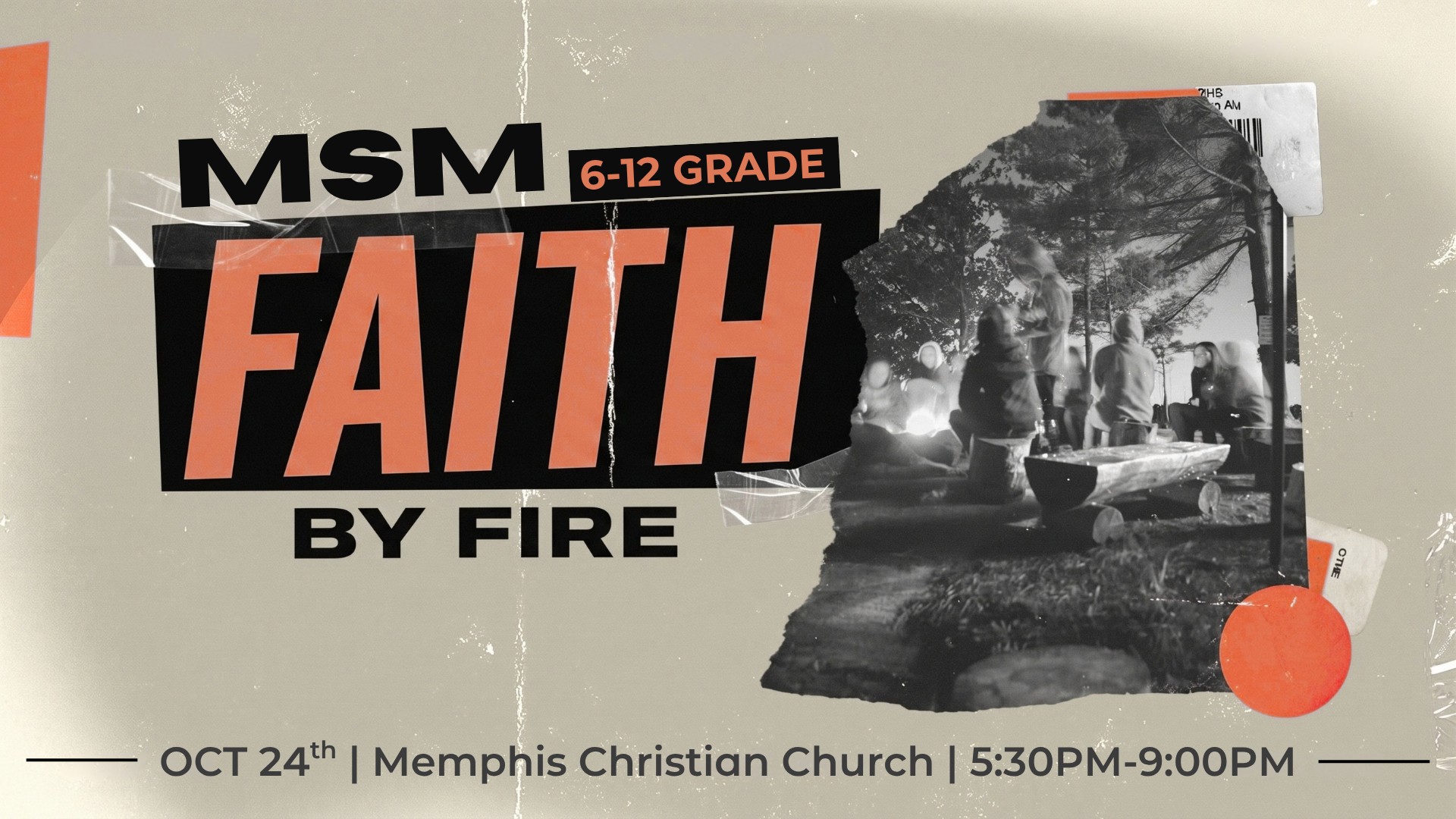
Memphis Student Ministry is bringing back FAITH BY FIRE! 6th-12th grade students will have the opportunity to build connections, and grow in their relationships with one another. Mark your calendar today.

This year's community Fall Festival will be on Saturday evening, October 31st. This is a great opportunity to love our community as more than 1,000 people will be on our property for trunk or treat, chili, hayrides, live shows, and more!
There is still a need for over 50 Team Members to be on the front lines. Please consider signing up.THESE SPOTS GO QUICK SO DONT DELAYClick below to claim your spot today!
ALL TEAM MEMBER MEETING:
WEDNESDAY, OCT. 28 MDWK (7:00p - 7:30p)
Immediately after MDWK Service, we will hold an ALL TEAM info/training session. We will provide overall details, expectations, and the heart of the event. Before you leave, you will meet with your Team Lead to get any further specific details.

My Journey Through Grief - Fall Session Thursdays 6:30pm Nov 5th, 12th, 19th, Dec 3rd, 10th, 13th Facilitated by Pastor Dave Colbert in partnership with Terri Mullins, provides a safe, encouraging, and healing atmosphere for all who are experiencing grief.
"The Resurrection"
Key Scripture: 1 Corinthians 15
Jesus declared “I am the resurrection and the life. He who believes in me will live, even though he dies; and whoever lives and believes in me will never die. Do you believe this?” (John 11:25-26) In the book of 1 Corinthians, chapter 15, the Apostle Paul writes to the church in Corinth. Paul is a man whose life was drastically changed by Jesus Christ.
Inspired by the Holy Spirit, Paul writes to address a particularly important issue. Some people in the church were saying there is no resurrection of the dead. That is an important issue because the resurrection is foundational to everything we believe. Because Jesus Christ rose from the dead, we who belong to Him can be certain that we, too, will be raised. That to be absent of the body is to be at home with The Lord.
In verses 12 through 34, Paul gives reason why this belief is essential to the Christian faith. If there is no resurrection then Christ has not been raised, our faith is futile, and death has the final word.
Today, I want us to focus on verses 1-11 understanding that the resurrection is more than a comforting idea that helps us cope with death. It is not a religious tradition passed down from one generation to another. The resurrection of Jesus Christ is an event in history, a truth supported by eyewitness testimony, a power that changes lives, and the foundation of our hope for eternity.
Paul begins, “Now, brothers, I want to remind you of the gospel I preached to you, which you received and on which you have taken your stand. By this gospel you are saved, if you hold firmly to the word I preached to you. Otherwise, you have believed in vain. For what I received I passed on to you as of first importance: that Christ died for our sins according to the Scriptures, that He was buried, that he was raised on the third day...” (1 Corinthians 15:1-4)
Notice Paul is not offering a personal opinion. He is not telling the church about a private spiritual experience that only he can understand. He is reminding them and us of a message they had already received and believed. This was the foundation of the Gospel they had heard from him when the church was established back in Acts Chapter 18. He is saying, we can be certain because the resurrection of Jesus Christ is rooted in history.
Notice the sequence in verse four. Paul is grounding the Christian faith in something that really happened. God entered our world in the person of Jesus Christ. Jesus lived among real people, taught in real places, performed miracles in front of witnesses, was put to death under the authority of Pontius Pilate, and was buried. Then, on the third day, He rose from the dead. These are all historically documented events. (The resurrection is not simply the idea that Jesus' influence lived on in the hearts of His followers. It is not that His disciples found a way to keep His teachings alive after His death. The Christian claim is much greater than that. The tomb is empty because Jesus is alive.)
All four Gospels testify to the discovery of the empty tomb. Matthew 28 records Mary Magdalene and the other Mary going to the tomb and encountering the angel who announced that Jesus had risen. Mark 16 tells of the women discovering that the stone had been rolled away and hearing that Jesus of Nazareth had been raised. Luke 24 records the women finding the stone rolled away, entering the tomb, and finding that Jesus' body was not there. John 20 describes Mary Magdalene discovering the empty tomb and running to tell Peter and the other disciple.
These accounts come to us through different Gospel writers, each emphasizing different details, proclaiming the same truth. Jesus, who had been crucified and buried, was no longer in the tomb.
The Christian faith announces that something happened in history that human beings could never accomplish for themselves. Jesus entered death and came out of the grave alive. The very thing that no human being can overcome by their own power, Jesus overcame.
This is why the resurrection matters so much. Because Jesus rose from the dead we must take seriously everything He said about Himself, everything He promised, and everything He taught about our relationship with God. Paul says in verse 3 that Christ died for our sins according to the Scriptures. His death was not an unfortunate accident that interrupted God's plan, it was the fulfillment of God's rescue plan. From the beginning, God was working to restore people who had been separated from Him by sin. Jesus came to do what we could never do for ourselves, to bear our sin, reconcile us to God, and open the way to eternal life. God entered human history, Jesus truly died, He was truly buried, and He truly rose again.
Paul does not stop with the empty tomb. We can be certain because Jesus was seen alive. In verses 5-8 he names people and groups who saw the risen Jesus. “…He appeared to Peter, and then to the Twelve. After that, He appeared to more than five hundred of the brothers at the same time, most of whom are still living, though some have fallen asleep. Then he appeared to James, then to all the apostles, and last of all he appeared to me also, as to one abnormally born.” (1 Corinthians 15:5-8) (Abnormally born means Paul came to Christ after Jesus had ascended into heaven.)
Why does Paul give us these names and details? Paul is appealing to eyewitness testimony. He is saying that people encountered the risen Jesus and they didn’t remain silent. Consider the Gospel accounts. In Luke 24, verse 13 two disciples are walking on the road to Emmaus, confused and disappointed by everything that had happened. They had hoped Jesus was the One, but He had been crucified. As they walk, Jesus appears to them, explains the Scriptures, and when He breaks bread with them their eyes are opened. They realize that the one walking with them is Jesus Himself. They immediately return to Jerusalem to tell the others what has happened.
John 20, verse 16, Mary Magdalene stands outside the tomb weeping. She is grieving because she believes Jesus' body has been taken away. Then Jesus speaks her name. She recognizes Him and goes to the disciples with the news that she has seen the Lord. Later, Jesus appears to His disciples, shows them His hands and His side, and they rejoice when they realize it is truly Him.
Thomas wasn’t present when Jesus first appeared to the disciples. When the others told him they had seen the Lord, he struggled to believe. He wanted evidence. He wanted to see the nail marks and the wound in Jesus' side. A week later, Jesus appeared again and invited Thomas to examine the evidence. Thomas responded, “My Lord and My God.”
Now, someone may say, "But I wasn't there. I didn't see the empty tomb. I didn't walk with Jesus on the road to Emmaus. I didn't put my hands where the nails had been." And that’s true. We were not eyewitnesses to the events of the first century. But neither do we personally witness every event in history that we accept as true. We rely on testimony, evidence, and the credibility of those who report what happened.
Think about a courtroom. A jury does not travel back in time to watch a crime take place. The jurors listen to witnesses, examine evidence, consider the consistency of the accounts, and determine what conclusion the evidence supports.
Paul is doing something similar in this passage. He identifies witnesses and points the church back to what was proclaimed from the beginning. He even notes that many of the five hundred were still alive when he wrote, so the claim was not presented as something hidden in the distant past, beyond anyone's ability to question.
We trust the Gospel not because we personally stood outside the tomb two thousand years ago, but because we have good reason to take seriously the testimony of those who did encounter the risen Christ. And the testimony does not end with Mary, Peter, Thomas, or the other disciples. It comes to us through the Scriptures, through the witness of the church, and through the continuing work of God in the lives of people who surrender to Jesus Christ today.
The resurrection is certain because it changed the people who saw it. The people who encountered the risen Jesus, their lives were transformed. Their fear gave way to courage. Their despair gave way to hope. Their confusion gave way to conviction. The people who had watched their teacher and Lord be crucified became the people who proclaimed that He was alive.
Look at Peter. Before the crucifixion, Peter had confidently declared that he would follow Jesus even if it cost him his life. Yet when Jesus was arrested, Peter denied knowing Him three times. He was afraid. He failed when the pressure came. He was a man who loved Jesus, but his courage did not match his promises. Now consider what happens after the resurrection. In Luke 24, the risen Jesus appears to Peter. In John 21, Jesus meets His disciples beside the Sea of Galilee and restores Peter after asking him three times whether he loves Him. Jesus does not pretend Peter's failure never happened. He restores him and gives him work to do - to care for His sheep.
Then, in Acts 2, we see Peter standing before a crowd in Jerusalem, boldly proclaiming Jesus Christ. This is the same Peter who had denied Jesus out of fear. Now he openly declares that God raised Jesus from the dead and calls people to repent and be baptized. What changed? Peter had encountered the risen Christ.
That is what the resurrection does. It changes the way we understand our past, our present, and our future. Peter's story reminds us that our worst failure does not have to define us. Jesus can forgive us, restore us, and put us back to work in His kingdom. Consider your own story.
Has your faith in the risen Jesus changed the way you live? Has it changed the way you speak to your spouse, raise your children, treat your neighbors, handle conflict, respond to temptation, or deal with someone who has hurt you? (I hope so) Does the resurrection influence what you do when nobody is watching? (It should) Does it affect the decisions you make when following Jesus costs you something? Paul writes, "Therefore, if anyone is in Christ, the new creation has come: The old has gone, the new is here!" (2 Corinthians 5:17) The resurrection is not merely a doctrine we defend. It is a truth that should transform the way we live. If Jesus is alive, then He is not simply someone we study from a distance. He is our living Lord, and He calls us to follow Him. Do you?This brings us to one of the most personal truths of the resurrection. It is not enough to believe that Jesus rose from the dead as a fact of history. We must understand what His resurrection means for those who put their faith in Him. Jesus rose, and because He rose, I can be raised with Him. In verses 1-2 of 1 Corinthians 15, Paul reminds us that this is the message on which we take our stand, by which we are being saved. It is the foundation of the salvation we receive through Jesus. Jesus didn’t rise from the dead simply to demonstrate His power. He rose because death could not hold Him, sin had been dealt with through His sacrifice, and God's plan to rescue His people was moving toward its ultimate victory.
In Romans 6:3–5 Paul explains that those baptized into Christ Jesus were baptized into His death, buried with Him through baptism, and raised to live a new life. He goes on to say that if we have been united with Christ in a death like His, we will certainly also be united with Him in a resurrection like His.
Think about your baptism. Baptism does not mean that you will never face another struggle, temptation, disappointment, or difficult season. It means that you have declared your trust in Jesus Christ who died for you and rose again. And that same invitation is available to every person today. You don’t have to clean yourself up before you come to Jesus. You come to Him in faith, confess your sin, receive His grace, and surrender your life to His leadership. You are baptized into Christ, and you begin learning what it means to walk in the new life He provides.
The resurrection is rooted in history. Jesus was seen alive. His resurrection transformed the lives of His followers. And the resurrection gives us certainty about our future.
“But Christ has indeed been raised from the dead, the first fruits of those who have fallen asleep.” (1 Corinthians 15:20) In the harvest, the first fruits were the beginning of what was to come. The first part of the harvest gave assurance that more of the harvest would follow. When Paul calls Jesus the “first fruits of those who have died”, he is teaching us that Jesus' resurrection is the beginning and guarantee of the resurrection still to come for those who belong to Him.
Think about how differently we approach life when we know the ending. For the Christian, we can face suffering without believing that suffering is the end of the story. We can endure hardship without surrendering our faith. We can serve faithfully even when nobody notices. We can forgive when forgiveness is costly. We can make sacrifices for the kingdom of God because we know that our labor is not in vain. And we can face death itself with hope. Not because we are unafraid, but because we know the One who has already passed through death and come out victorious.
The question for us today isn’t simply do you believe? The question is whether you have placed your faith in the One who rose from the dead. Jesus, who declared, “I am the resurrection and the life. He who believes in me will live, even though he dies; and whoever lives and believes in me will never die. Do you believe this?” (John 11:25-26)
This is your opportunity to take your next step in faith by being baptized, or writing out a prayer to God with your questions. Declare publicly your decision to live with certainty because of Jesus’ resurrection. I look forward to seeing you at The Gathering. Dave